Choose running boards by confirming your truck’s model year, cab configuration, body version, and mounting requirements before comparing width, finish, or price. A board that looks right beside the doors still needs the correct brackets and a verified fit for your particular truck.
It is easy to start shopping with appearance in mind. Black or polished? Flat or oval? Those choices matter, but they come after compatibility. Finding your truck’s name in a product title is only the beginning.
A little preparation helps narrow the options and gives the seller useful information if anything needs checking.
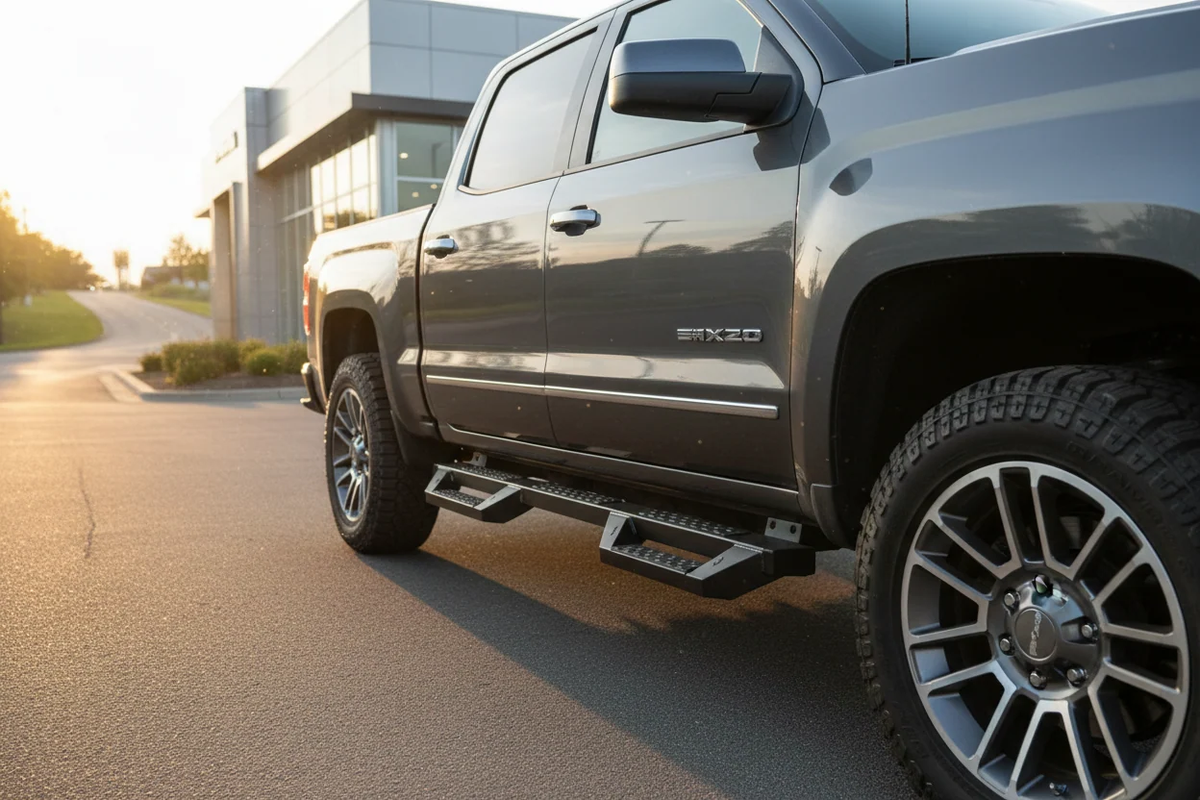
Start With Your Truck’s Exact Details
Write down the make, model, model year, and full cab description before browsing. Add any body-version designation and relevant modifications. Keep these details together so you can compare listings without relying on memory.
Use vehicle documentation or manufacturer information to confirm anything uncertain. The year you bought the truck is not necessarily its model year, and a previous owner’s description is not a substitute for checking its configuration.
For accessories that depend on additional dimensions, provide those too. However, do not use bed length alone to identify a cab. Check the actual requirements listed for the particular board and bracket combination.
As you browse running boards, read the fitment information and selected options, not just the headline. Save the product code for any shortlisted set so customer support knows exactly which item you are considering.
Check Cab Type and Body Version Separately
Cab type deserves its own check. Do not assume that a product for one four-door configuration automatically fits another, or that a familiar cab label means the same thing across manufacturers.
Read every qualifier attached to the listing. A Crew Cab requirement should be treated as part of the fitment information, not an incidental description.
Body-version labels also matter. TonnoMonster lists separate six-inch products for RAM 1500 Classic and RAM 1500 New Body, with Crew Cab information on the individual pages. The shared RAM 1500 name is not enough to choose between them.
This is why a shortlist should be based on a complete match rather than a similar-looking truck in a photograph. Where a year range, cab description, or body designation is unclear, ask the seller to confirm the exact product code before paying.
Look Beyond the Board to the Mounting Kit
The visible step is only part of the purchase. Ask which brackets, fasteners, and instructions come with the kit, and whether they correspond to your vehicle configuration.
Request the installation guide before ordering when possible. Check what attachment points it specifies and whether any additional parts or modifications are required. Do not interpret a general “bolt-on” description as permission to skip the vehicle-specific instructions.
For a truck that already has side steps, mud flaps, or other accessories near the mounting area, provide that information to the seller. Ask whether anything must be removed or whether the proposed kit has known restrictions.
Have questionable mounting areas inspected by a qualified installer, particularly where damage or corrosion is visible. If the supplied brackets do not match the documented installation, stop and resolve the discrepancy rather than drilling or improvising a connection.
Choose a Step You Will Actually Use
Once compatibility is confirmed, consider how you and your passengers get into the cab. A driver wearing work boots may want a different stepping layout from someone choosing mainly for appearance.
Compare the usable step surface, not simply the advertised width. Ask whether the stated measurement describes the overall board, the tube, or the area intended for your foot. Look at where the step pads sit relative to both front and rear doors.
Check installation photographs for the same vehicle configuration and ask about the step’s position below and outside the door opening. A close-up product image cannot show that relationship.
Where possible, try a comparable installed set with your usual footwear. Notice where your foot lands rather than judging usefulness from the widest advertised dimension.
For a family truck, think about rear-seat access as carefully as the driver’s side. For a modified truck, describe the changes and ask the installer to assess the finished stepping position. A compatible mounting kit does not by itself establish that the resulting step will meet everyone’s needs.
Compare Materials Without Forgetting the Complete Assembly
Material is worth comparing, but it should not replace the fitment check. TonnoMonster’s collection separates aluminum, carbon steel, and stainless steel options, giving shoppers several categories to investigate once they have identified compatible products.
Read the specification for the complete assembly, including the brackets, surface finish, and step pads. Do not assume that every component uses the same material as the visible board.
Ask for the stated load capacity and how it applies to the installed product. Clarify any conditions rather than interpreting “heavy-duty” as a measurable rating.
Consider maintenance alongside appearance. Request cleaning guidance appropriate to the finish, especially when the truck encounters mud or winter road treatments. An advertised traction surface should not be treated as a reason to leave snow, ice, or other contamination on the step.
Choose the option whose documented requirements fit your use, not the one with the strongest marketing adjectives.
Confirm the Details Before Checkout
Send the seller a short, specific question rather than asking only, “Will this fit my truck?” Include the vehicle details, product code, relevant modifications, and any unresolved installation questions.
When comparing truck running boards, use TonnoMonster’s vehicle selector as a starting point, then verify the selected product’s own fitment information. Keep the seller’s written confirmation with your order records.
Compare the full purchase, including the mounting kit, delivery charges, and any professional installation you expect to need. A lower product price is not automatically a lower completed cost.
Read the current return and warranty terms before ordering. Check the conditions around opening the packaging, assembling components, or attempting installation. Understand the process for an incorrectly supplied item separately from one ordered using the wrong vehicle details.
Inspect the Delivery Before Installation
When the package arrives, compare its labels and product code with your order. Lay out the parts against the supplied inventory, check for damage, and retain the packaging while any questions are resolved.
Read the installation guide fully before beginning. Assess the tools, working conditions, and assistance required; choose professional installation when the job exceeds your experience.
Use the specified installation sequence and torque values rather than figures from a different kit or an unrelated online video. After installation, follow the manufacturer’s inspection and maintenance instructions.
If anything appears incorrect, document it and contact the supplier before modifying parts. Catching a mismatch at this stage is preferable to trying to make an unsuitable kit work.
Fit First, Finish Second
The best-looking boards are only a useful purchase when they suit the truck and the people using it. Confirm the vehicle configuration, mounting kit, and installation requirements first. Then compare stepping space, materials, and appearance.
That order keeps the decision practical. Instead of hoping a product will fit because the model name looks familiar, you can buy with a clear record of what has been checked.
Facebook Comments